Selling options pays you a premium, and the premium is biggest where implied volatility (IV) is highest. That is also where the risk is highest. A stock with 400% IV isn't a bargain. It is a stock the market expects to swing wildly. This guide shows how to start from a list of high-IV contracts and screen it for covered call and cash-secured put setups you would actually consider.
What the high-IV list contains
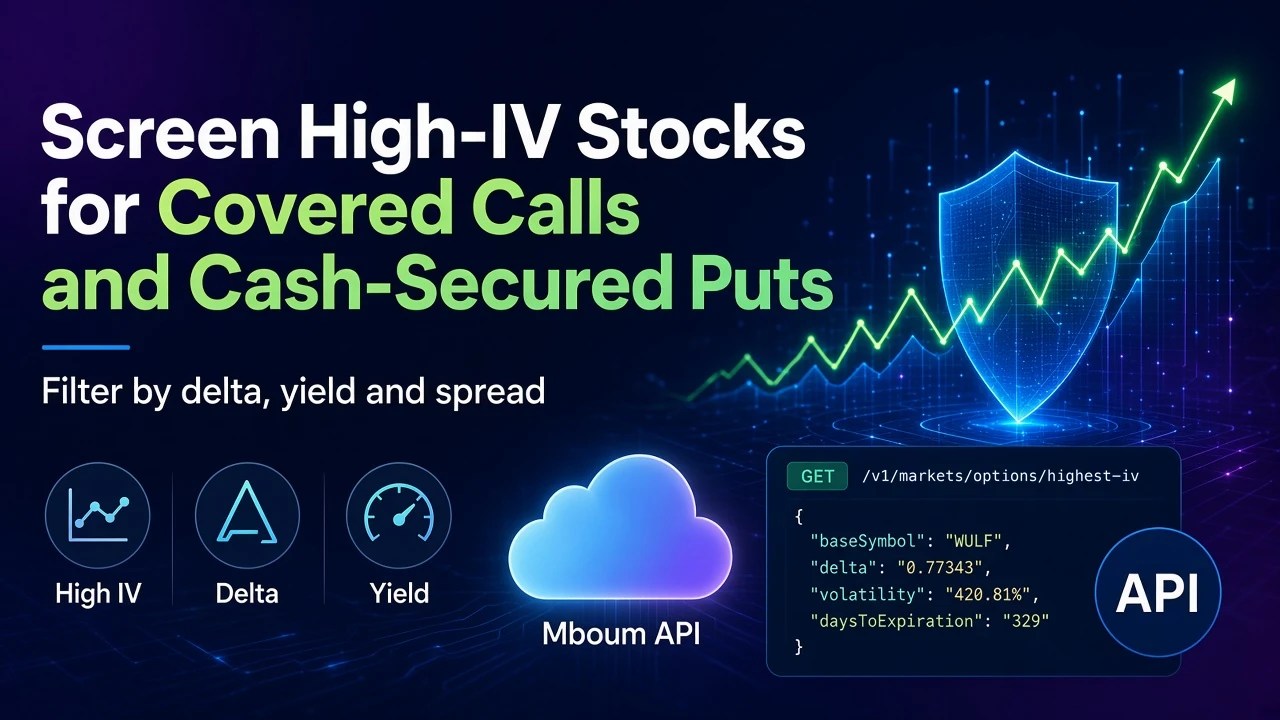
Mboum's Highest Implied Volatility data is an API endpoint, GET /v1/markets/options/highest-iv. It returns the 20 stock option contracts with the highest IV that pass these filters: IV of at least 60%, 15 or more days to expiration, a last price of at least $0.10, volume of at least 500 and open interest of at least 100. Each row has the underlying price, strike, expiration, bid, ask, volume, open interest, delta and IV.
Two limits matter. The list is always the first 20 results, sorted highest IV first, whatever you send for page. And it holds contracts of both types, deep in the money and far out of the money, so most rows are not covered call or put-selling candidates until you filter them. meta.total tells you how many contracts passed the filters.
Step 1: choose the side
- Covered call: you own 100 shares and sell a call above the current price. You collect the premium and give up gains above the strike.
- Cash-secured put: you hold cash equal to the strike times 100 and sell a put below the current price. You collect the premium and agree to buy at the strike if the stock falls below it.
In both cases, ask first whether you would be happy to own the stock (or keep owning it) at that price. A fat premium doesn't help if you wouldn't hold the shares.
Step 2: use delta to keep strikes out of the money
Delta is a rough guide to how likely a contract is to finish in the money. Many sellers pick strikes with an absolute delta of about 0.30 or lower, though the cutoff is a personal choice. In the docs example, one call has a delta of 0.77 and another 0.97. Those are deep in the money and they are not covered call candidates. Keep calls with a strike above the stock price and puts with a strike below it.
Step 3: measure the premium fairly
Use the bid, the price you can actually sell at, not the last trade. Divide it by the stock price for a call, or by the strike for a put. Then scale it to a year to compare contracts that expire on different dates.
Worked example, with made-up numbers for a stock called XYZ trading at $50:
- Covered call: sell the $55 call, 30 days out, for a $1.20 bid. Premium yield is 1.20 ÷ 50 = 2.4%, about 29% annualized. If the stock is called away, you keep the $5 gain plus the premium: $6.20, or 12.4%. Your break-even on the shares drops to $48.80.
- Cash-secured put: sell the $45 put, 30 days out, for a $1.10 bid. You set aside $4,500. Premium yield is 1.10 ÷ 45 = 2.4%, about 30% annualized. If you are assigned, your effective purchase price is $43.90.
The annualized figure is a way to rank contracts. It is not a forecast, because the same trade can't be repeated on a schedule and assignment changes the position.
Step 4: check what the premium is paying for
- Earnings and news. IV often jumps before a report. Check the Upcoming Earnings page for a date before the expiration.
- Whether IV is high for this stock. The Implied Volatility Rank page shows IV, IV Rank (1Y) and IV Percentile (1Y) for each symbol. A stock with IV near the top of its own one-year range has more reason to be rich than one that always trades at high IV. Filters on that page need a free Mboum account.
- Liquidity. A wide bid-ask spread or low open interest means you may not get the bid you calculated.
Get this as JSON
GET https://api.mboum.com/v1/markets/options/highest-iv has weight 2 per call. The sort parameter is required and takes HIGHEST or LOWEST, but results always come back highest IV first. See the endpoint docs. This script applies Steps 1 to 3 to the list:
import requests

URL = "https://api.mboum.com/v1/markets/options/highest-iv"
HEADERS = {"Authorization": "Bearer YOUR_MBOUM_API_KEY"}


def num(value):
    return float(str(value).replace(",", "").replace("%", "").replace("+", ""))


def fetch():
    resp = requests.get(URL, headers=HEADERS, params={"sort": "HIGHEST"}, timeout=30)
    data = resp.json()
    if resp.status_code != 200 or not isinstance(data.get("body"), list) or not data["body"]:
        raise SystemExit(f"Request failed: {str(data)[:150]}")
    return data


def screen(rows, max_delta=0.30):
    picks = []
    for r in rows:
        spot, strike = num(r["baseLastPrice"]), num(r["strikePrice"])
        bid, ask = num(r["bidPrice"]), num(r["askPrice"])
        dte, delta = num(r["daysToExpiration"]), abs(num(r["delta"]))
        if bid <= 0 or delta > max_delta:
            continue
        if r["symbolType"] == "Call" and strike > spot:
            kind, base = "covered call", spot
        elif r["symbolType"] == "Put" and strike < spot:
            kind, base = "cash-secured put", strike
        else:
            continue
        picks.append({
            "symbol": r["baseSymbol"], "kind": kind, "strike": strike, "dte": dte,
            "iv": r["volatility"], "delta": delta,
            "yield_pct": round(bid / base * 100, 2),
            "annualized_pct": round(bid / base * 365 / dte * 100, 1),
            "spread_pct": round((ask - bid) / ((ask + bid) / 2) * 100, 1),
        })
    return sorted(picks, key=lambda p: p["annualized_pct"], reverse=True)


if __name__ == "__main__":
    data = fetch()
    print(f"{data['meta']['total']} contracts passed the endpoint filters; screening the first {len(data['body'])}")
    picks = screen(data["body"])
    for p in picks:
        print(p)
    if not picks:
        print("Nothing passed. Try a higher max_delta, or check one ticker's chain.")
Because the list is only 20 rows, many runs return few or no matches. When you have a ticker in mind, pull its full chain from /v3/markets/options and apply the same screen to the rows for that stock.
Sample response
A trimmed row from the docs example, with the fields the script reads:
{
  "baseSymbol": "WULF",
  "baseLastPrice": "2.14",
  "symbolType": "Call",
  "strikePrice": "1.50",
  "daysToExpiration": "329",
  "bidPrice": "1.35",
  "askPrice": "2.05",
  "delta": "0.77343",
  "volatility": "420.81%"
}
This row would not pass the screen. The strike is below the stock price, and the delta is 0.77.
Best practices
- Check the body. A 200 response can carry an error message and no
bodylist. The script exits in that case. - Parse the strings. Values such as
"420.81%"and"2,594"need cleaning before you do math. Thenum()helper does it. - Respect the rate limit. The limit is 10 requests per second, and over it returns HTTP 429. Only HTTP 200 responses count toward weight.
- Treat extreme IV as a warning. The highest IVs often belong to small, volatile stocks. A rich premium there reflects real risk.
Next steps
Run the screen, then check each survivor for earnings, liquidity and your own willingness to hold the shares. This is for education only and is not investment advice.
Claim your free API key and see the Mboum docs for Python, PHP, JavaScript and Bash samples.