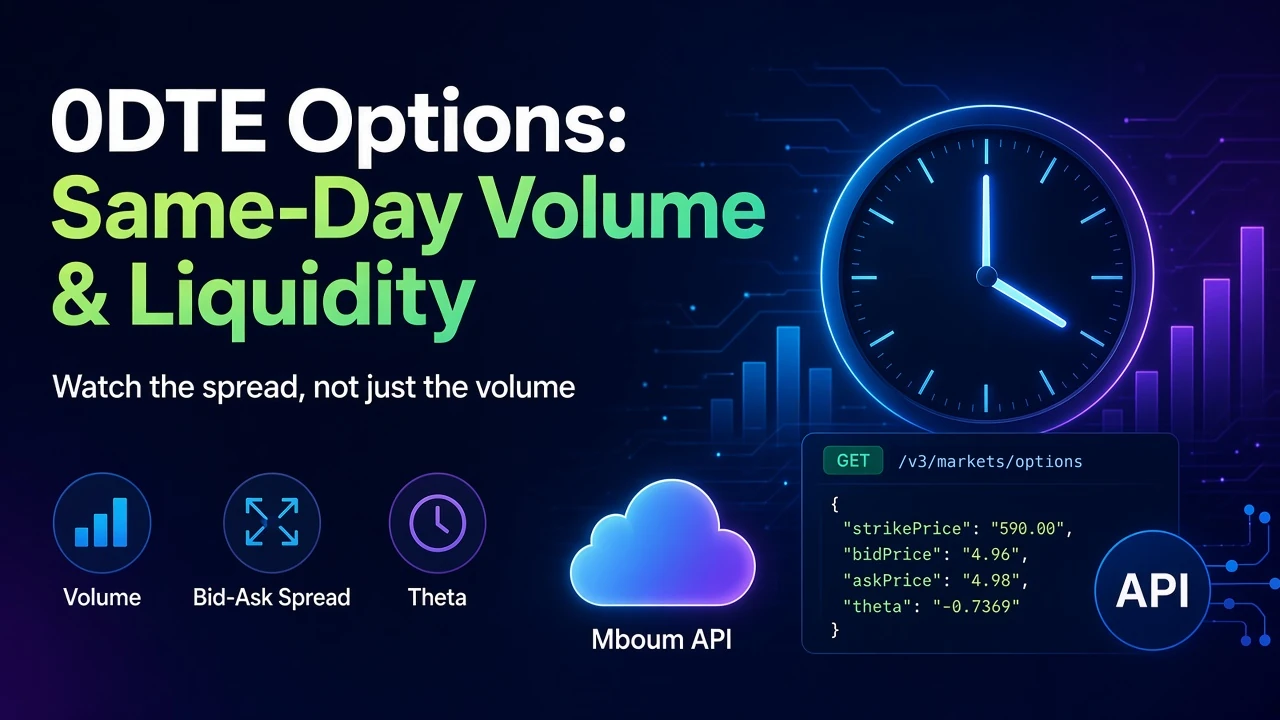
A 0DTE contract expires the day you trade it. That compresses everything. Volume can be enormous, quotes can be thin at the wrong strike, and time decay does not wait. Two questions matter before any same-day trade. Where is the volume? And what does it cost to get in and out? This guide shows how to answer both with the Unusual Options Activity page and the Mboum options chain data.
What 0DTE means on Mboum
The scanner has a DTE column. It shows calendar days until the contract expires. A DTE of 0 means it expires today. The Days to Expiration filter has a choice called "Expires today", followed by Under 2, 3, 5, 10 and 15 days.
Filters, and pages after the first, need a free Mboum account. The page says so: "Create a free account to access this data. Log in or register to see more pages and use the filters."
What the same-day list looked like
On Nov 11, 2026 I read the whole list. Every row expired that day. It held 980 contracts on six underlyings: MU, TSLA, AMD, MSFT, AVGO and AMZN. NVDA was not on it. The page only lists contracts with volume of at least 500, open interest of at least 100, a last price of at least $0.10 and Vol/OI above 1.24. A liquid name can trade heavily and still miss the cut.
The list changes every session. Do not expect the same tickers tomorrow.
Volume tells you where. The spread tells you the cost.
Volume shows where traders are active. It does not show what it costs to trade. For that, compare bid and ask. Here are three rows from the page (Last Trade 2:06 PM ET and 2:03 PM ET):
- TSLA $392.50 put: bid $0.50, ask $0.53, mid $0.52. Volume 84,623. The spread is $0.03, about 5.8% of the midpoint.
- MU $835.00 call: bid $0.51, ask $0.54, mid $0.53. Volume 41,804. The spread is $0.03, about 5.7% of the midpoint.
- MSFT $525.00 call: bid $0.15, ask $0.17, mid $0.16. Volume 38,274. The spread is $0.02, about 12.5% of the midpoint.
All three had huge volume. The MSFT contract is still the most expensive to trade, because the same two cents is a much larger share of a 16-cent option. If you buy at the ask and sell at the bid, you give up the whole spread. At 12.5%, the option must gain about that much just to break even. One contract covers 100 shares, so the $0.02 spread costs $2 per contract on the round trip.
Theta: the clock on a 0DTE option
Mboum's chain data describes theta as the dollar amount an option loses each day from the passage of time. On a 0DTE contract the "day" is the whole remaining life, so decay is not a slow leak. Time value tends to run out fast as the close nears.
The scanner page does not show theta. It does show Delta. In the same snapshot, the MU $835.00 call had a delta of 0.121 with the stock at $818.81. That is a cheap, far out-of-the-money contract. Nearly all of its price is time value, and all of it goes to zero if the stock does not get there before the bell. Get theta from the chain endpoint below.
A checklist for tracking same-day volume and liquidity
- Volume against open interest. A Vol/OI of 805.93 on 105 open contracts is mostly a small denominator. Use the ratio to find contracts, then look at size.
- Est. Value Traded. The TSLA put above shows $4.40M. That is premium, not stock exposure.
- Spread as a percent of midpoint. (ask − bid) ÷ mid. Compare contracts on this number.
- Last Trade time. The row shows when it last traded. An old timestamp means a stale quote.
- Delta. Know whether you are holding a near-the-money contract or a lottery ticket.
- Earnings or news today. Check Upcoming Earnings and News.
Get this as JSON
Two endpoints cover this, both weight 2:
GET https://api.mboum.com/v1/markets/options/unusual-options-activityreturns the scanner list. Keep rows wheredaysToExpirationis"0".GET https://api.mboum.com/v3/markets/optionsreturns one expiration, grouped intoCallandPut. Sendtickerandexpiration(YYYY-MM-DD). Each contract hasbidPrice,askPrice,midpoint,volume,openInterest,deltaandtheta. See the chain docs.
Values are formatted strings, so parse them. Some failures return HTTP 200 with a message and no data, so check the body. If you send no expiration, the endpoint defaults to the week's Friday, which is not what you want for 0DTE.
import requests
from datetime import datetime
from zoneinfo import ZoneInfo

URL = "https://api.mboum.com/v3/markets/options"
HEADERS = {"Authorization": "Bearer YOUR_MBOUM_API_KEY"}


def num(value):
    return float(str(value).replace(",", "").replace("%", "").replace("+", ""))


today = datetime.now(ZoneInfo("America/New_York")).strftime("%Y-%m-%d")
resp = requests.get(URL, headers=HEADERS, params={"ticker": "TSLA", "expiration": today}, timeout=30)
body = resp.json().get("body")
if not isinstance(body, dict) or "Call" not in body:
    raise SystemExit(f"No chain for {today}: {resp.json()}")

for side in ("Call", "Put"):
    for c in body[side]:
        mid = num(c["midpoint"])
        if num(c["daysToExpiration"]) != 0 or mid <= 0 or num(c["volume"]) < 1000:
            continue
        spread_pct = (num(c["askPrice"]) - num(c["bidPrice"])) / mid * 100
        print(side, c["strikePrice"], f"vol {c['volume']}", f"spread {spread_pct:.1f}%",
              f"delta {c['delta']}", f"theta {c['theta']}")
A trimmed contract from the docs example (SPY, three days to expiration):
{
  "symbol": "SPY|20250530|590.00C",
  "strikePrice": "590.00",
  "bidPrice": "4.96",
  "midpoint": "4.97",
  "askPrice": "4.98",
  "volume": "39,945",
  "openInterest": "30,435",
  "delta": "0.5518",
  "theta": "-0.7369",
  "daysToExpiration": "3"
}
Next steps
Treat volume as a map and the spread as the price of entry. Check both, check the clock, and size positions for a contract that can go to zero by the close. This is education, not investment advice.
Claim your free API key and see the Mboum docs for Python, PHP, JavaScript and Bash samples.