An options chain looks like a wall of numbers. Strikes, bids, asks, Greeks, volume, open interest. Most of it matters, but not all at once. This guide reads one chain row at a time, using the fields the Mboum chain endpoint returns, and ends with a checklist for picking a contract. The Mboum website has scanner pages for options but no chain page, so this guide works from the API response.
What a chain is
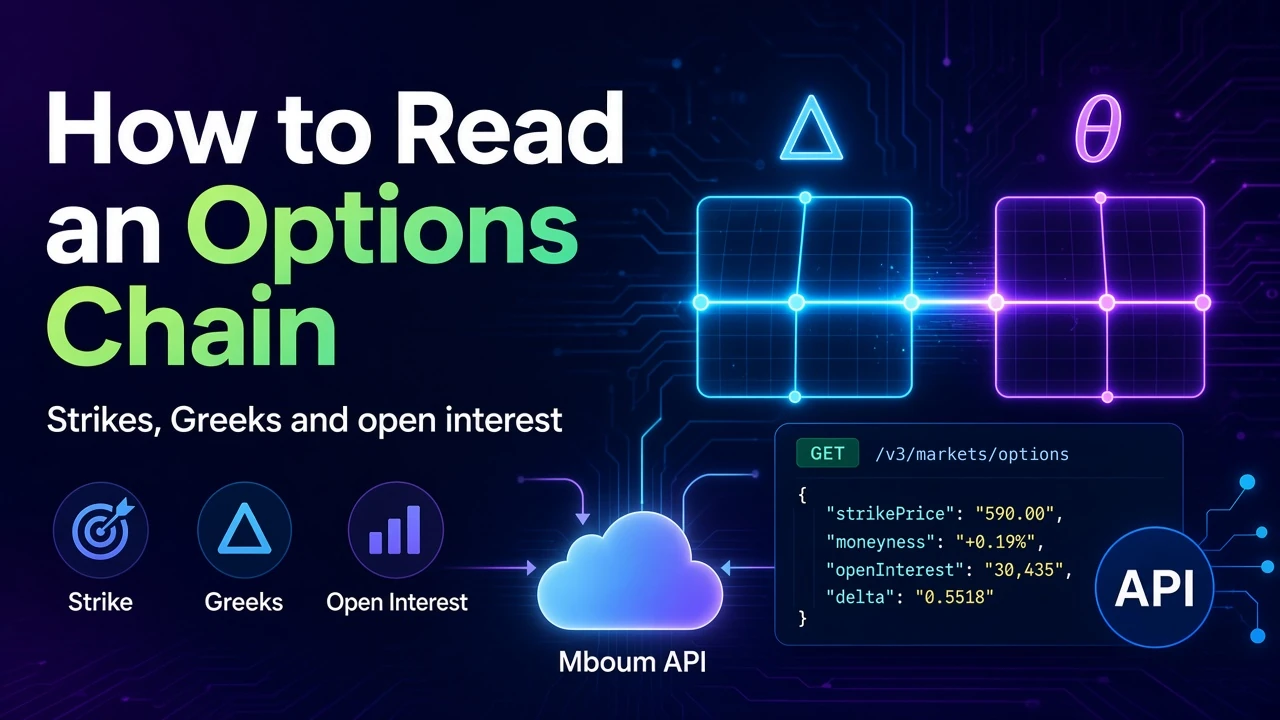
A chain lists every listed contract on one stock, ETF or index. Each strike has a call and a put. Each expiration date has its own set of strikes. Mboum's /v3/markets/options endpoint returns one expiration at a time, split into a Call list and a Put list, sorted by strike. The meta.expirations object lists the available dates, grouped as weekly and monthly.
Read one call, field by field
These values come from the docs example: SPY, the $590.00 call expiring 05/30/25.
- strikePrice 590.00 is the price at which the holder can buy the stock (a call) or sell it (a put).
- daysToExpiration 3 is the number of days until the contract expires.
- moneyness +0.19% shows how far the stock sits from the strike. The call shows +0.19% and the put at the same strike shows −0.19%, so the sign tracks whether each contract is in or out of the money. The field description gives the base as underlying price minus strike price.
- bidPrice 4.96, askPrice 4.98, midpoint 4.97 are what buyers will pay, what sellers want, and the point between. The spread is $0.02, about 0.4% of the midpoint. That is tight.
- lastPrice 5.00, priceChange +3.40, percentChange +212.50% describe the last trade against the previous day's settlement. Last can sit away from the current quote, so trust the bid and ask first.
- volume 39,945 is how many contracts traded today.
- openInterest 30,435 is how many contracts are open. openInterestChange +2,108 is the change in that number. A rise means more positions are open than before. A fall means positions were closed.
- delta 0.5518 is the sensitivity of the option's price to the stock's price. Roughly, the option moves $0.55 for each $1 move in SPY.
- theta −0.7369 is time decay. On a $5.00 option, that is about 74 cents of premium per share each day, all else equal. One contract covers 100 shares.
- vega 0.2120 is the sensitivity of the option's price to changes in volatility.
The docs text says the Greeks include rho. The example response shows delta, vega and theta, so check the live response before you rely on rho.
Volatility fields
The same row carries four volatility numbers. volatility 20.08% is the contract's implied volatility. averageVolatility 18.63% is the average IV of the calls and puts just above and below the stock price. historicVolatility30d 19.69% is realized volatility over the last 30 days. impliedVolatilityRank1y 17.80% places at-the-money IV within its one-year range.
Here the contract's IV is a little above the 30-day realized figure, and the rank is low. That says options are priced near the recent stock moves and low against their own year. It says nothing about direction.
Calls and puts at the same strike
Compare the $590.00 put in the same example:
- Bid $3.21, ask $3.23, midpoint $3.22. The spread is $0.02, about 0.6% of the midpoint.
- Volume 23,676 against 39,945 for the call.
- Open interest 7,496 against 30,435 for the call. Open interest change −281, so positions were closing.
- Delta −0.4438. Puts carry negative delta because the price rises when the stock falls.
- Theta −0.6105. Both sides lose value as time passes.
Call volume was larger than put volume at this strike, and call open interest was far larger. That tells you where positions sit. It does not tell you who is right.
A checklist for picking a contract
- Liquidity first. Spread as a percent of midpoint, then open interest. Wide spreads and low open interest cost you on exit.
- Delta for intent. A delta near 0.50 is near the money. A delta of 0.10 is a long shot.
- Theta against time. Compare theta with the premium. A large share of premium lost per day means the stock must move fast.
- IV against history. Compare
volatilitywithhistoricVolatility30dandimpliedVolatilityRank1ybefore you pay up. - Open interest change. Rising open interest means positions are building. Falling means they are closing.
- Calendar. Check Upcoming Earnings before you pick an expiration.
To find contracts worth opening a chain for, start from the Unusual Options Activity scanner. Its rows show strike, bid, mid, ask, volume, open interest, IV and delta for each contract.
Get this as JSON
GET https://api.mboum.com/v3/markets/options has weight 2. Send ticker (required; you can send symbol instead) and an optional expiration in YYYY-MM-DD format. Without an expiration, the endpoint returns this week's Friday, or next Friday once this week's has passed. See the chain docs.
Values arrive as strings such as "+2,108" and "20.08%", so parse them. Some failures return HTTP 200 with a message and no data, so check the body.
import requests

URL = "https://api.mboum.com/v3/markets/options"
HEADERS = {"Authorization": "Bearer YOUR_MBOUM_API_KEY"}


def num(value):
    return float(str(value).replace(",", "").replace("%", "").replace("+", ""))


resp = requests.get(URL, headers=HEADERS, params={"ticker": "SPY"}, timeout=30)
data = resp.json()
body = data.get("body")
if not isinstance(body, dict) or "Call" not in body:
    raise SystemExit(f"No chain: {data}")

print("Expirations:", data["meta"]["expirations"])

for side in ("Call", "Put"):
    for c in body[side]:
        mid = num(c["midpoint"])
        if mid <= 0 or num(c["openInterest"]) < 1000:
            continue
        spread = (num(c["askPrice"]) - num(c["bidPrice"])) / mid * 100
        print(side, c["strikePrice"], c["moneyness"], f"spread {spread:.1f}%",
              f"OI {c['openInterest']} ({c['openInterestChange']})",
              f"delta {c['delta']}", f"theta {c['theta']}")
A trimmed call row from the docs example:
{
  "symbol": "SPY|20250530|590.00C",
  "strikePrice": "590.00",
  "moneyness": "+0.19%",
  "bidPrice": "4.96",
  "midpoint": "4.97",
  "askPrice": "4.98",
  "volume": "39,945",
  "openInterest": "30,435",
  "openInterestChange": "+2,108",
  "volatility": "20.08%",
  "delta": "0.5518",
  "vega": "0.2120",
  "theta": "-0.7369",
  "daysToExpiration": "3"
}
Next steps
Read liquidity first, then Greeks, then volatility. A contract that passes all three is a candidate, not a recommendation. This is education, not investment advice.
Claim your free API key and see the Mboum docs for Python, PHP, JavaScript and Bash samples.