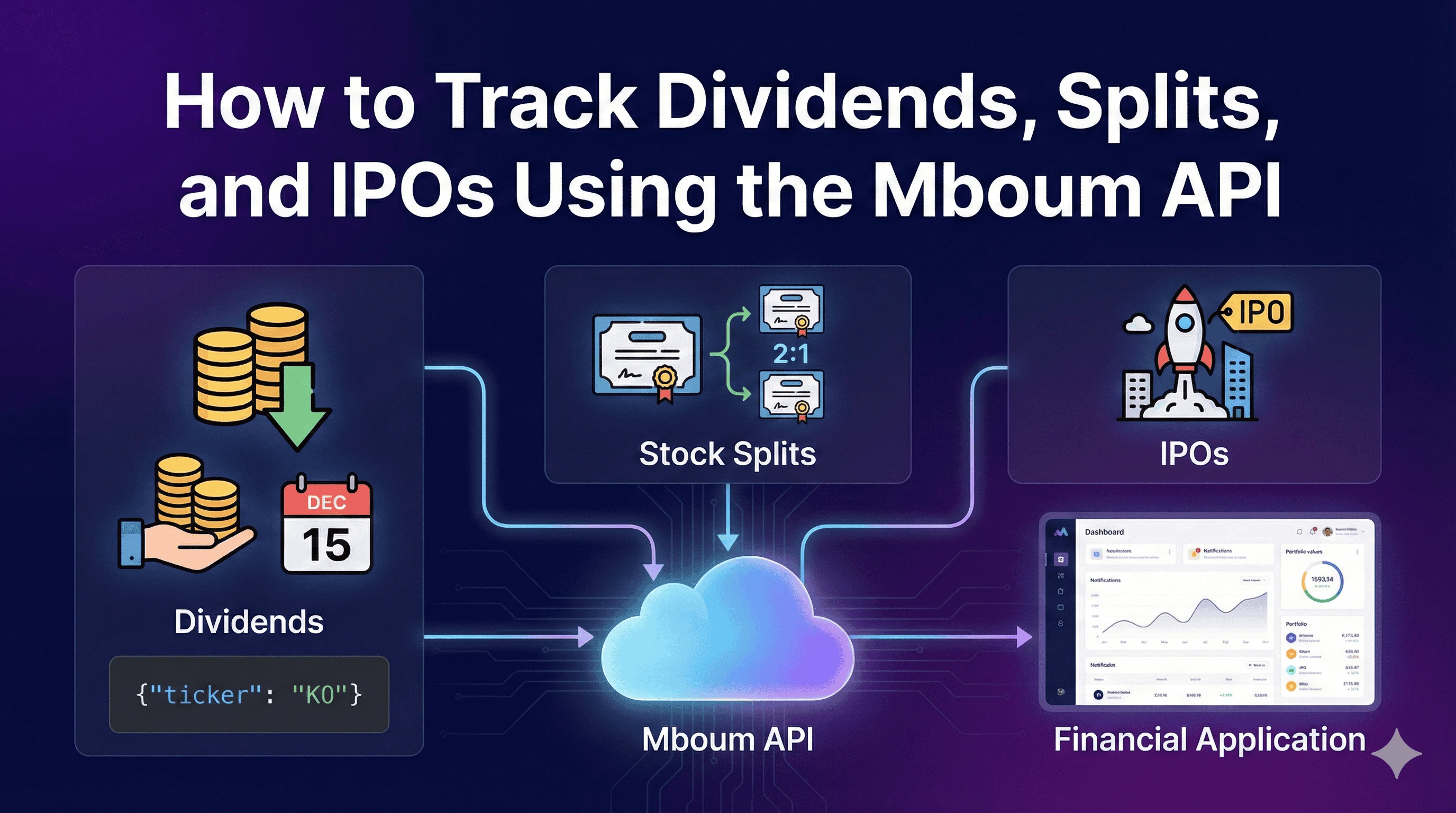
Corporate actions are events initiated by a public company that bring material change to the company and affect its stakeholders. For developers building financial applications, tracking these events is critical. Stock splits alter the price and share count of a position, while dividends represent taxable income and cash flow. Furthermore, tracking Initial Public Offerings (IPOs) allows investors to identify new market entrants immediately.
The Mboum API provides dedicated endpoints to track these calendar events programmatically. This guide details how to integrate dividend schedules, stock split history, and IPO calendars into your financial software.
👉 To access these endpoints, you must obtain an API key: https://mboum.com/pages/api
The Calendar Endpoints
Mboum organizes these datasets under the Calendar Events section of the API. Below are the specific endpoints required to track these events.
1. Dividends
To retrieve past, present, and upcoming dividend data, use the Dividends endpoint. You can filter this data by a specific company using the ticker parameter or retrieve a broad list by date.
Documentation:
https://docs.mboum.com#stocks-options-GETapi-v1-markets-calendar-dividends
2. Stock Splits
Stock splits increase or decrease the number of shares in a corporation. This endpoint returns the split ratio, which is essential for adjusting historical price charts and cost basis calculations.
Documentation: https://docs.mboum.com#stocks-options-GETapi-v1-markets-calendar-stock-splits
3. IPO Calendar
This endpoint provides data on companies that are in the process of going public. It includes details such as the proposedSharePrice and the dealStatus (e.g., whether it has been priced or withdrawn).
Documentation: https://docs.mboum.com#stocks-options-GETapi-v1-markets-calendar-ipo
Python Example: Fetching Dividend Data
The following example demonstrates how to fetch dividend information for a specific stock, such as Coca-Cola (ticker: KO), using the Python requests library. This script requests the dividend calendar filtered by the ticker parameter.
import requests
import json

# Define the endpoint URL
url = "https://api.mboum.com/v1/markets/calendar/dividends"

# Set up the query parameters
# We use 'ticker' to filter for a specific company
querystring = {"ticker": "KO"}

# Include your API key in the headers
headers = {
    "Authorization": "Bearer {YOUR_AUTH_KEY}"
}

try:
    # Make the GET request
    response = requests.request("GET", url, headers=headers, params=querystring)

    # Parse the JSON response
    data = response.json()

    # Print the output
    print(json.dumps(data, indent=4))

except requests.exceptions.RequestException as e:
    print(f"Error fetching data: {e}")
Understanding the Response
When you request dividend data, the API returns a list of objects containing the dates and rates relevant to the payout. Below is a simplified example of the JSON response structure you will receive.
{
    "body": [
        {
            "symbol": "KO",
            "companyName": "Coca-Cola Company (The)",
            "dividend_Ex_Date": "2023-11-30",
            "payment_Date": "2023-12-15",
            "record_Date": "2023-12-01",
            "dividend_Rate": 0.46,
            "indicated_Annual_Dividend": 1.84,
            "announcement_Date": "2023-10-19"
        }
    ]
}
Key Fields
-
dividend_Ex_Date: 2023-11-30
The date on or after which a security is traded without a previously declared dividend. -
payment_Date: 2023-12-15
The scheduled date on which a declared dividend is paid. -
dividend_Rate: 0.46
The individual dividend amount per share for this specific payout. -
indicated_Annual_Dividend: 1.84
The projected total dividend amount for the year based on the current rate.
Practical Use Cases
Dividend Capture Strategy
Traders utilizing a dividend capture strategy aim to buy a stock just before the ex-dividend date and sell it shortly after. By programmatically monitoring the dividend_Ex_Date field via the API, you can generate alerts for high-yield stocks approaching this critical date.
Portfolio Accounting and Splits
When a stock split occurs, the value of the shares changes, but the market capitalization remains roughly the same. Failing to account for this can break historical performance charts. By monitoring the stock splits endpoint, your system can detect when old_share_worth differs from share_worth and automatically adjust the quantity of shares held in a user's portfolio to maintain accurate accounting.
IPO Alerting
Investors often look for early entry points into newly listed companies. Using the IPO endpoint, you can track the dealStatus to filter for Priced deals or monitor upcoming sections to notify users of new investment opportunities before they hit the general market.
Accurate tracking of corporate actions is fundamental for any robust financial application. Whether you are adjusting portfolio data for stock splits or capturing income through dividends, the Mboum API provides the necessary structured data to automate these processes.
👉 Start integrating corporate action data today: https://mboum.com/pages/api