A contract that normally trades a few hundred lots suddenly prints 200,000. Is someone positioned for a move, or is it noise? The Unusual Options Activity page on Mboum puts these contracts in one table. It shows what traded. It does not show why. This guide covers how to read the table, how to separate same-day contracts from the rest, and why volume alone never gives you direction.
What "unusual" means on Mboum
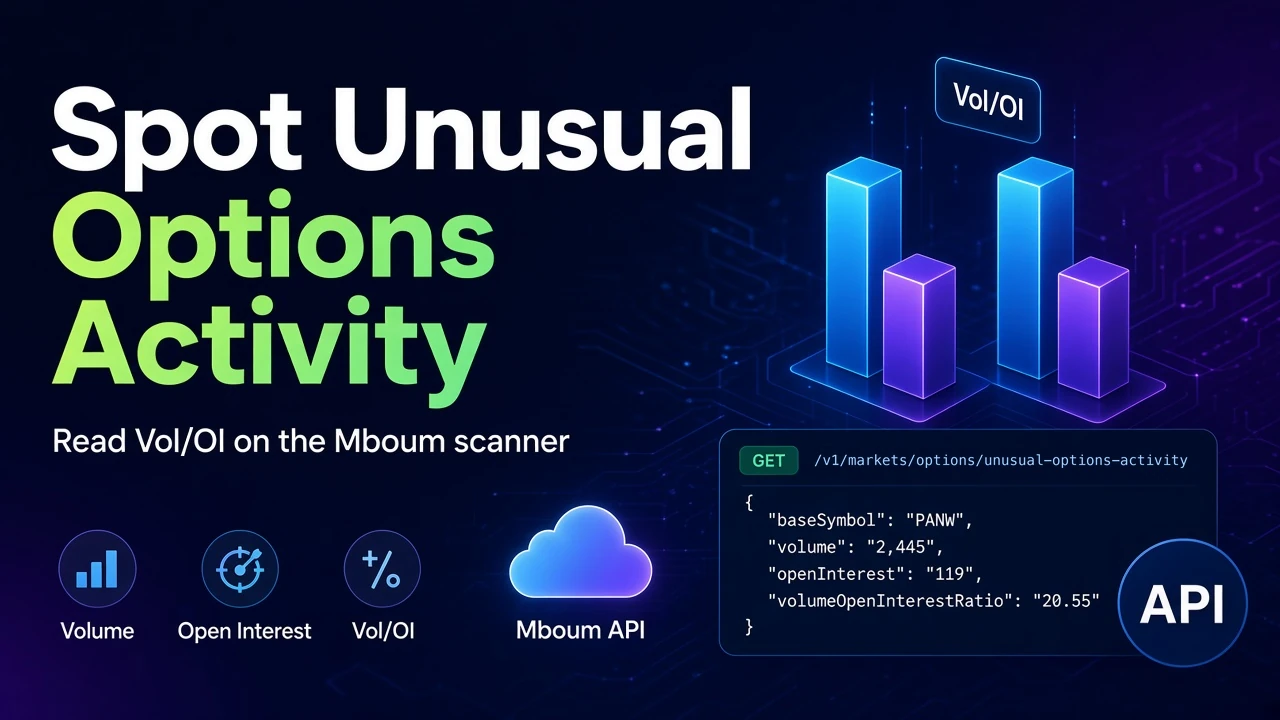
The page defines it in one line: option contracts where today's volume is high compared with open interest. The measure is Vol/OI, today's volume divided by open interest. Above 1 means more contracts traded today than were open coming into the day.
The list is pre-filtered. It covers standard weekly and monthly contracts that expire in under 30 days, with volume of at least 500 contracts, open interest of at least 100, a last price of at least $0.10, and Vol/OI above 1.24. Rows are sorted by Vol/OI, highest first.
A worked example
This is a snapshot from the page on Nov 11, 2026, around 1:36 PM ET:
- Contract: TSLA $395.00 call, expiring Nov 11, 2026
- Volume: 203,129
- Open interest: 2,624
- Vol/OI: 77.41 (203,129 ÷ 2,624)
- Last: $0.56, delta 0.331
- Est. Value Traded: $11.38M (203,129 × $0.56 × 100 shares per contract)
Now compare the TSLA $392.50 put on the same day. Its Vol/OI is 729.36, more than nine times higher. But open interest was only 105, so a small denominator inflated the ratio. The dollar value was $4.06M, far below the call. Rank by the ratio to find candidates. Judge them by size.
Read each row in this order
- Volume and Open Interest. Is the ratio large because volume is large, or because open interest is tiny?
- Est. Value Traded. Premium changing hands. $140K and $34.91M are not the same signal.
- DTE. Calendar days to expiration. 0 means the contract expires today.
- Delta. A delta of 0.03 is a far out-of-the-money lottery ticket. A delta of 0.68 behaves much more like owning the stock.
- Bid, Mid, Ask, Last. Where Last sits against the quote hints at who was more eager. One print is a hint, not proof.
- IV and Last Trade. Implied volatility, and how fresh the row is.
Filter same-day contracts from longer-dated ones
The scanner has these filters: Symbol, Underlying (Stocks, ETFs, Indices), Stock Price, Option Last Price (Under $0.50 up to Under $5.00), Days to Expiration (Expires today, then Under 2, 3, 5, 10 or 15 days) and Min Vol/OI (Over 2 up to Over 25). Click a column header to sort the rows on the page. Export CSV downloads the rows. Filters and pages after the first need a free Mboum account.
Here is what the Nov 11 snapshot showed. I paged through all 49 pages, 980 rows. Every row expired that day. On a session like that, the Days to Expiration filter changes nothing, because the list is already all same-day.
Same-day contracts start the morning with little open interest, so modest volume produces a huge Vol/OI. Contracts that expire later tend to carry more open interest, so they need far more volume to clear the same ratio. So treat the two groups differently:
- Expires today: raise Min Vol/OI, then rank by Est. Value Traded. Ignore ratios on cheap contracts with small open interest.
- Under 10 or 15 days: check the DTE column. Rows that survive here have more time to play out and deserve a closer look when they appear.
Volume is not direction
The page says it plainly: high volume shows activity, not intent. A trade can open or close a position, and this data does not show whether the buyer or the seller started it. A big call print can be:
- A buyer betting on a rise
- A seller writing the call against shares
- One leg of a spread
- Someone closing an old position
- A dealer hedging another trade
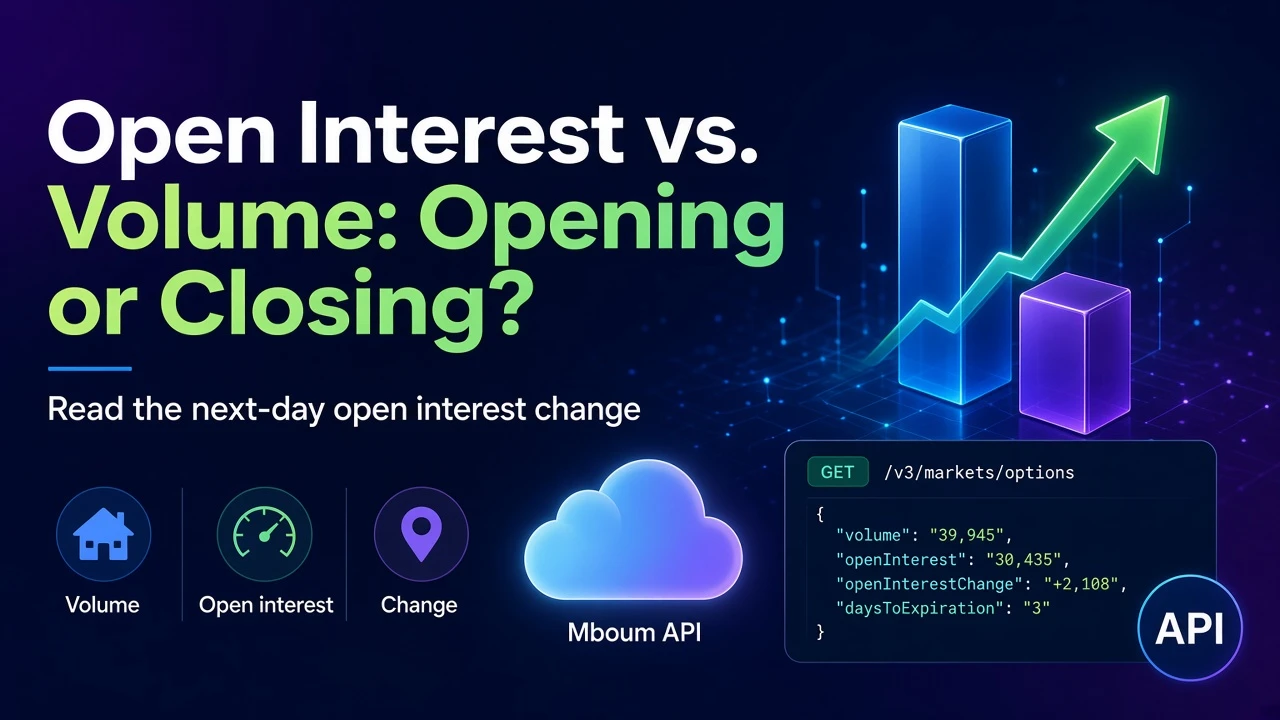
Open interest updates once a day. Compare tomorrow's open interest with today's volume. If open interest rose by a large share of the volume, new positions were opened. If it barely moved, many trades were closing.
A checklist before you trust a row
- Is an earnings date close? Check Upcoming Earnings.
- Is there news? Check News.
- Is the contract liquid? A wide bid-ask spread makes the last price unreliable.
- Did the stock already move? Compare Stock Price with the strike.
- Did open interest change the next day?
Get this as JSON
The same list comes from GET https://api.mboum.com/v1/markets/options/unusual-options-activity (weight 2). Documented parameters: type (STOCKS, ETFS or INDICES), ticker (or symbol), date (a past list, YYYY-MM-DD), price_min and page. See the endpoint docs.
Values come back as formatted strings such as "2,445" and "151.81%", so strip the commas and signs before you do math. The response has no value-traded field, so compute it. Some failures return HTTP 200 with a message and no body list, so check the body.
import requests

URL = "https://api.mboum.com/v1/markets/options/unusual-options-activity"
HEADERS = {"Authorization": "Bearer YOUR_MBOUM_API_KEY"}


def num(value):
    return float(str(value).replace(",", "").replace("%", ""))


resp = requests.get(URL, headers=HEADERS, params={"type": "STOCKS", "page": 1}, timeout=30)
data = resp.json()
rows = data.get("body")
if not isinstance(rows, list):
    raise SystemExit(f"No rows returned: {data}")

for row in rows:
    value = num(row["volume"]) * num(row["lastPrice"]) * 100
    if num(row["daysToExpiration"]) >= 1 and value >= 500_000:
        print(row["symbol"], row["volumeOpenInterestRatio"], f"${value:,.0f}")
A trimmed row looks like this:
{
  "symbol": "PANW|20240223|310.00C",
  "baseSymbol": "PANW",
  "symbolType": "Call",
  "strikePrice": "310.00",
  "daysToExpiration": "1",
  "lastPrice": "0.14",
  "volume": "2,445",
  "openInterest": "119",
  "volumeOpenInterestRatio": "20.55",
  "volatility": "151.81%",
  "delta": "0.01892"
}
Next steps
Unusual activity is a starting point for research. Check size, check expiration, and check what happened to open interest the next day before you form a view. This is education, not investment advice.
Claim your free API key and see the Mboum docs for Python, PHP, JavaScript and Bash samples.